Pricing Guide
How to price sports cards
The full comps playbook for show vendors: which tools to trust (and which to pay for), how to price raws and slabs, what dealers actually pay, and how to verify any graded card at the table.
Updated July 2026. Tool prices and grading fees change; we reverify this page when they do.
The short version
- Price to recent sold prices, never asking prices. The last two or three sales of the same card in the same grade are the market.
- eBay solds are the final word for most cards. Crossed-out prices hide accepted Best Offers; 130point.com shows them free.
- Card Ladder ($20 a month, free tier available) is the deepest data in the hobby and worth it once real money crosses your table.
- Raw cards price off raw solds, never off a percentage of the PSA 10.
- Dealers pay 50 to 80 percent of comps in cash depending on liquidity. That's standard dealer math.
- Verify every slab you buy: cert lookup plus a physical check. The fakes got good.
The foundation
How do I find out what a card is actually worth?
Sold prices are the only prices
A card is worth what the last few buyers paid for it, in that grade, this month. That's a comp: a comparable sale, same card, same parallel, same grade, recent. Everything in this guide is a way of finding comps faster and reading them better. What you paid for the card is a memory, not a price. An asking price is a wish. The comp is the market, and the market does not care about either one.
Does one big sale reset the market?
No. One screaming result is an outlier until the next two or three sales confirm it. Somebody sniping a card at 6am or two bidders losing their minds on a Sunday night does not move what the card is worth on Saturday at your table. Price to the cluster, not the spike. Same rule in reverse: one desperation sale below the cluster is not a crash.
Illustration
What a sales-history chart is telling you
Dots are individual sales; the line is the modeled value. Two things to read off any chart like this: the direction of the line (is the player heating up or cooling off) and how tightly the dots cluster. Tight cluster means a confident price. Scattered dots mean the market hasn't agreed yet, so leave yourself room. And that one dot way above the line? That's an outlier, not your new sticker price. (Mock chart, illustrative only.)
The king
Is Card Ladder worth it for a vendor?
The deepest data in the hobby
Card Ladder tracks over 100 million sales going back to 2000, pulled from roughly 40 sources: eBay, Goldin, Fanatics Collect, Heritage, Alt, MySlabs, REA, and the rest of the auction-house alphabet. Owned by Collectors, PSA's parent, since December 2021. Where eBay shows you 90 days of one marketplace, Card Ladder shows you the card's whole life across all of them. That's the difference between guessing a trend and knowing it.
What CL Value actually is
CL Value is a modeled estimate, not the last sale. It anchors to the most recent sale, then moves every day with the player's index, so a card that hasn't sold in four months still shows a live number instead of a stale one. When a new sale lands, the value snaps to reality. For thin-sale cards, that model is the closest thing the hobby has to a fair mark. If it disagrees with the last sale, the market moved since that sale.
Free vs Pro, and the honest weakness
The free tier covers value search, hobby news, daily sales recaps, and the Card Ladder Index. Pro is $20 a month or $200 a year and unlocks full sale-by-sale history, collection tracking, and price alerts. If you're setting up more than a couple times a year, the first mispriced slab it prevents pays for months of it. The weakness: it's a pure data tool. No deal finder, no inventory workflow, no submission tracking. It tells you the price; running the business is on you.
The final word
How do I read eBay sold prices?
The Sold filter, done right
Search the card, then check Sold Items and Completed Items in the filters. You're now looking at roughly the last 90 days of real transactions, newest first. Match the exact parallel and grade before you read anything: a Silver Prizm comp tells you nothing about the base card, and a PSA 9 comp tells you nothing about your raw copy. Need history past 90 days? Terapeak, inside eBay Seller Hub, is free with a seller account and reaches back years.
Illustration
Reading a sold-listings page
2020 Prizm Justin Herbert #325 PSA 10
$118.00
2020 Prizm Justin Herbert #325 PSA 10
$124.50
2020 Prizm Justin Herbert #325 PSA 10
Best offer accepted, real price hidden. 130point.com reveals it: $112.
$135.00
The struck-through price is the tell. That card did not sell for $135; the seller took a hidden Best Offer. Count enough of those at face value and your sticker ends up 15 percent over the real market. (Mock results for illustration.)
130point: the hidden-price decoder
130point.com/sales is the free, ad-supported tool that reveals what accepted Best Offers actually closed at, the numbers eBay strikes through and hides. Search the card there before you trust any crossed-out comp. On higher-end cards where half the sales are Best Offer deals, skipping this step means pricing off fiction.
The toolbox
What are the best pricing tools, and which are free?
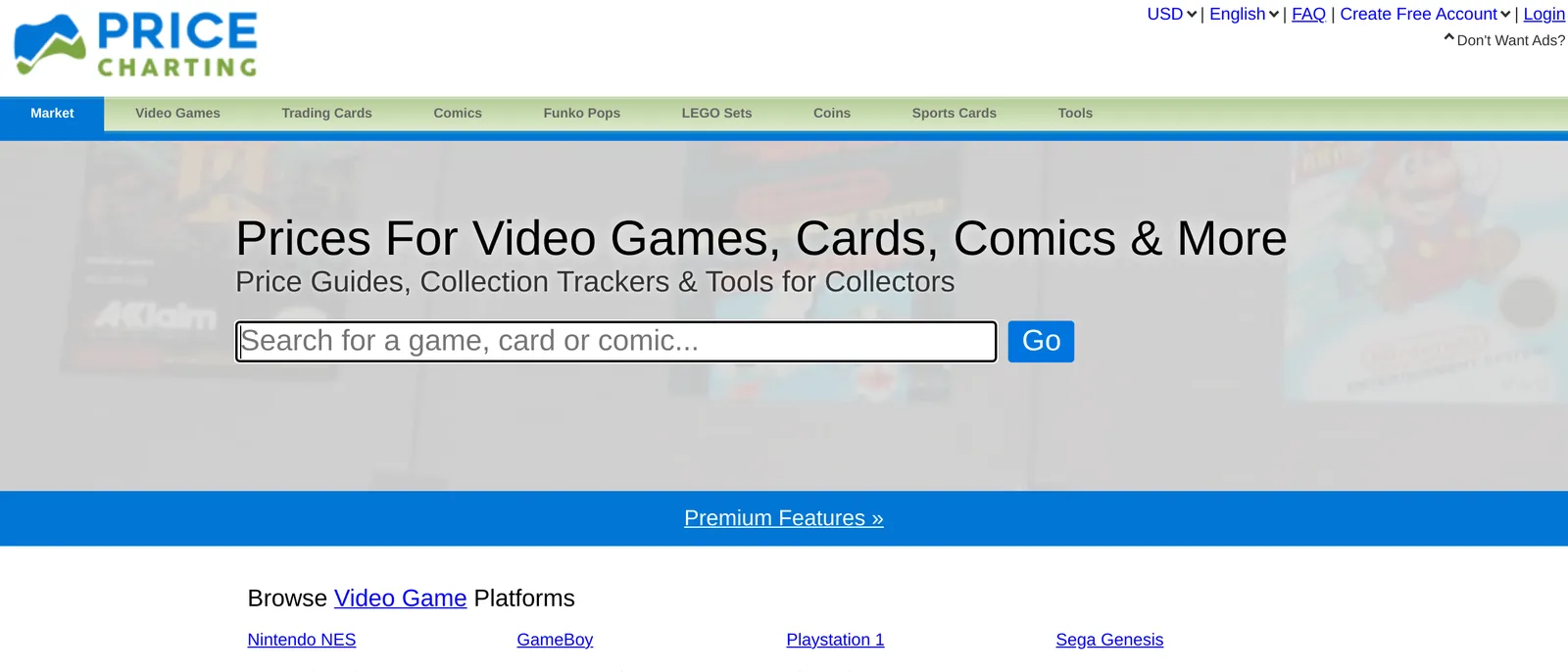
PriceCharting / SportsCardsPro: the raw-card answer
Same engine, two skins; sportscardspro.com is the sports one. The free guide shows a weighted average price per condition tier: Ungraded, grade 7, 8, 9, 9.5, PSA 10, BGS 10. That explicit ungraded column makes it the only mainstream tool that answers "what's my raw worth" directly, which is why it earns a bookmark even with its known flaw: sale auto-matching sometimes pollutes a card's page with the wrong parallel, so sanity-check weird numbers against eBay solds. A Collector subscription runs $6 a month or $59 a year; the free guide covers everything table pricing needs.
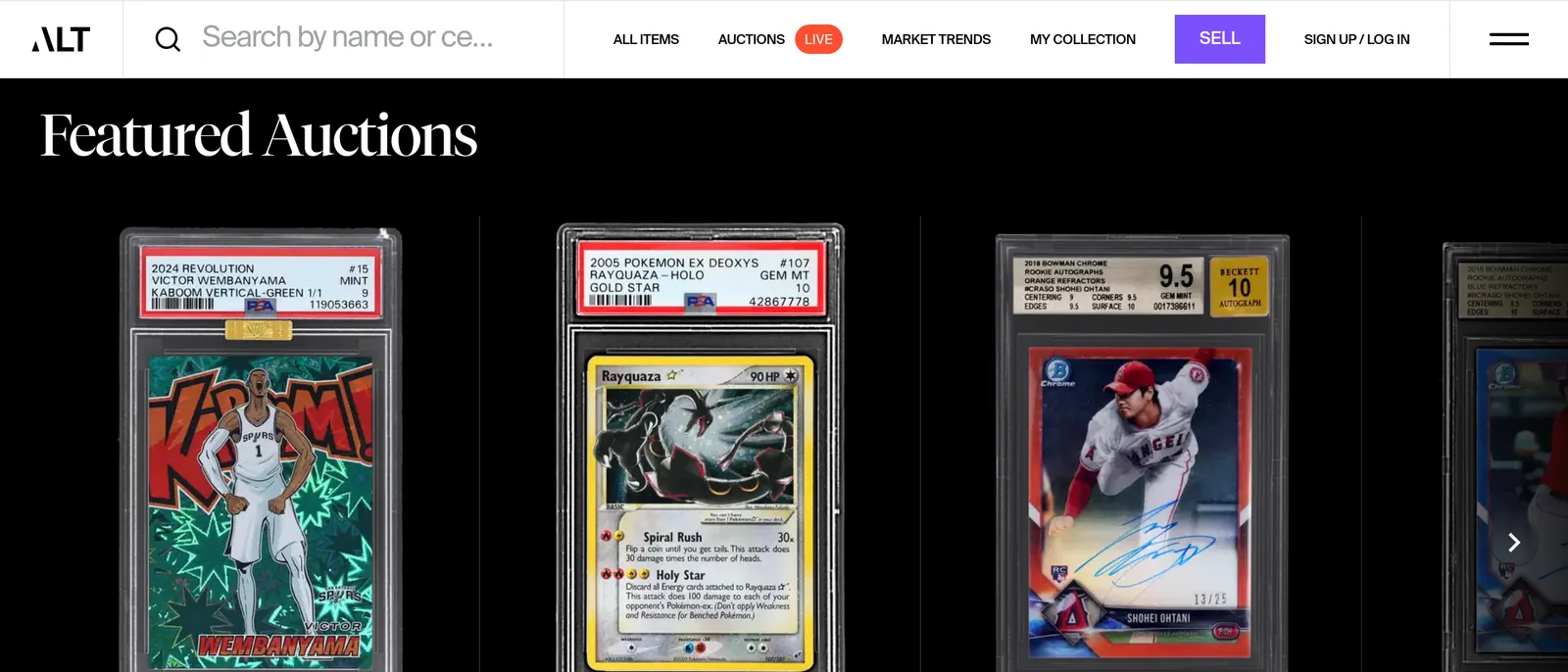
ALT: free values for graded cards
ALT runs a machine-learning value model (Alt Value) over PSA, BGS, and SGC sales, and its Instant Pricer shows recent transactions across marketplaces plus population data. All free with an account. Graded cards only, so it's the slab cross-reference: when Card Ladder and eBay disagree, ALT is the tiebreaker vote.
Market Movers: the workflow app
From Sports Card Investor. Slick interface, population data next to prices, a deal-finder that flags underpriced live listings, and strong Pokemon coverage. Tiers: Starter $9.99, Premium $24.99, Unlimited $49.99 a month (annual plans knock roughly 17 percent off). The catch: its data leans eBay-centric, so auction-house sales are thinner than Card Ladder's. Head to head for pure pricing, Card Ladder wins. As a buying and portfolio tool, Market Movers earns its keep. Plenty of full-time vendors run both; if you pay for one, pick by which side of your business needs help.
TCGplayer: for the TCG side of your table
If you carry Pokemon or other TCG singles, raw prices live on TCGplayer. Use Market Price (a rolling average of completed sales), not Lowest Listing, which is just somebody's ask. The show-floor norm is to price raw TCG at or a touch under Market Price; sports-style haggling is less common on that side of the aisle. TCGplayer does not cover sports cards, which is exactly why the tools above exist.
Raw math
How do I price raw cards?
Raw solds, never a percentage of the 10
The classic mistake is pricing a clean raw as "half of PSA 10 money." Buyers don't pay that, because they're the ones taking the grading risk. Price off raw solds: filter eBay to ungraded copies, or read the Ungraded column on SportsCardsPro. A card that genuinely might gem can carry a small premium over raw comps, never 10 money. And know the grade curve before you dream: a PSA 9 usually brings only a modest premium over a clean raw, and sub-9 grades can sell for less than the raw would have. Slabbing a card does not automatically make it worth more.
Vintage prices under the gauged grade
For raw vintage, gauge the grade honestly, then price at a small discount to that grade's comps. A card you'd call a 6 prices just under PSA 6 money. The buyer gets a fair shot at the upside, the card moves, and that buyer comes back next month. Disclose damage out loud and on the sticker; a hidden crease costs you a customer forever.
To slab or not
Is it worth grading cards before selling them?
The math rule
Grade when two things are true: the card is worth about $50 or more raw, and the realistic graded outcome is at least double the raw price plus the grading fee. Grade the card you have, not the card you hope you have; be brutal about corners and centering before paying a fee to find out. Everything below that bar sells raw, in a penny sleeve, this weekend, and the money compounds into the next buy.
The mid-2026 reality check
The cheap-grading era is on pause. PSA suspended its Value tiers in June 2026 under a mountain of submissions, so its cheapest open tier is Regular at $79.99 a card. TAG's budget tiers are paused too. That leaves SGC at $15, BGS Base at $14.95 (if you can wait 75 business days), and CGC at $17 to $20 as the budget routes, and it means the "graded at double raw plus fees" bar sits a lot higher at PSA right now. Rerun the math for each grader before you submit; the full grader breakdown is below.
Published service fees are only the starting cost. Minimum quantities, memberships, declared-value limits, upcharges, shipping, insurance, and turnaround time can change the real cost per card. Confirm the current order total before using any grading-return calculation.
Buying
What do dealers actually pay for cards?
The 50 to 80 percent reality
There's no rulebook here, but common hobby practice is that dealers pay 50 to 80 percent of recent comps in cash, scaled by liquidity. A card that resells this weekend earns the top of the range; a card that will sit in the case for six months earns the bottom, because your money sits with it. When you're the one buying at the table, say your math out loud: "it comps at $100, I can do $70 cash." Sellers respect a number with a reason attached. Trades run richer than cash, 80 to 85 percent for liquid, 50 to 60 for slow; the full trade playbook is in the setup guide.
Table practice
How should I price cards at a card show?
Sticker at comps, leave a lane
Sticker at recent comps with a little negotiation room built in, because show buyers expect to work you down and both sides should get to feel good about the handshake. Round numbers move faster than $47.63. Reprice the week of the show, not the month before; a hot player's comps from May are fiction in July. Removable price labels make Friday-night repricing painless, and a price on everything beats "make me an offer" nine times out of ten, because if people have to ask, most won't.
Read the room, then hold your numbers
Walk the floor before doors open and note what other tables ask for cards you carry; asking prices are useless for value but priceless for positioning. Then trust your comps. The vendor who panic-matches every neighbor's sticker by noon ends up selling comps-minus-twenty all day. If a card is priced right and gets real interest but no sale, the price isn't the problem yet. Three shows of "what sold, what got picked up and put down" notes will out-teach any market report.
Know your slabs
Which grading company is best?
The 2026 lay of the land
Five graders matter at a show table, and the scoreboard isn't close: per GemRate, the hobby's grading-volume tracker, 26.8 million cards were graded in 2025 (PSA 19.26M, CGC 4.92M, SGC 1.42M, Beckett 824K, TAG 440K), and June 2026 set an all-time monthly record at 3.5 million. One structural fact to know: Collectors, PSA's parent, now also owns SGC (2024), Beckett (2025), and Card Ladder, which puts roughly four of every five graded cards under one roof. CGC, backed by Blackstone, is the big independent. Here's what each slab means when it hits your table.
PSA
The liquidity king
Founded 1991, owned by Collectors. The first card it ever graded, cert #00000001, is the T206 Honus Wagner. PSA grades more cards than everyone else combined: 19.26 million in 2025, about 72 percent of the market, and a record 2.5 million in June 2026 alone (per GemRate).
- Volume (GemRate): 19.26M cards in 2025 · record 2.50M in June 2026
- Cost to grade: Regular $79.99 (40 to 50 business days). The cheap Value tiers ($24.99 to $64.99) are paused as of June 2026 due to demand.
- Cert check: psacard.com/cert. Enter the cert number from the label. Shows grade, year, brand, subject, and a PSA price estimate. Population counts live in the separate pop report.
- At your table: PSA slabs are the format every buyer recognizes and prices fastest, which makes them the easiest slabs to move at a table. The flip side in 2026: with Value tiers paused, grading table stock through PSA starts at $79.99 a card, which kills the math on mid-value raws until they reopen.
CGC Cards
The fast-growing No. 2
Born from CGC, the comic grader founded in 2000 (parent CCG, majority owned by Blackstone since 2021). Entered cards in 2020 and merged its card operations into CGC Cards in 2023. The largest grader not owned by PSA’s parent.
- Volume (GemRate): 4.92M cards in 2025 (up 121%) · record 763K in June 2026
- Cost to grade: Bulk $17 (about 120 working days), Economy $20 (about 65 days), Standard $55 (about 10 days).
- Cert check: cgccards.com/certlookup. Enter the cert number or scan the QR code on the label back. Shows the card, grade, and photos CGC took of the actual slab, plus a link into the pop report. The photos make it the strongest lookup for spotting swapped or faked slabs.
- At your table: The value play. Cheap bulk grading, a usable 10-day Standard tier, and a direct pipeline into Fanatics Collect (CGC grades inside their facility with sub-2-day turnaround). Strongest liquidity on TCG tables, where most of its growth is coming from.
BGS (Beckett)
Subgrades and the Black Label
Beckett has been the hobby’s price-guide name since 1984; BGS launched grading in 1999. Acquired by Collectors (PSA’s parent) in December 2025 and rebuilding fast under new management: a record 146K cards graded in June 2026.
- Volume (GemRate): 824K+ cards in 2025 · record 146K in June 2026
- Cost to grade: Base $14.95 without subgrades or $17.95 with (75+ business days), Standard $34.95 with subgrades (45 business days).
- Cert check: beckett.com/grading/card-lookup. Enter the serial number, pick BGS, and hit Verify. Shows the card description, the grade, and the subgrades. Beckett itself tells sellers to link the lookup in their listings.
- At your table: The only major grader that prints four subgrades (centering, corners, edges, surface) on the label, and the BGS 10 Black Label is still the premium flex in the hobby. Standard BGS 9.5s trade below PSA 10s, so expect wider spreads on non-Black-Label inventory.
SGC
The vintage specialist
Founded in 1998 and based in Boca Raton, acquired by Collectors in February 2024 and positioned as the boutique brand. Volume has contracted hard on modern (down 67 percent year over year by mid 2026), but vintage baseball is its lane: by GemRate data, more than 20 percent of graded vintage sports cards wear the tuxedo slab.
- Volume (GemRate): 1.42M cards in 2025 · 39K in June 2026
- Cost to grade: Standard $15 (advertised 40 to 50 business days), Expedited $150 (2 to 3 business days).
- Cert check: gosgc.com/cert-code-lookup. Enter the cert code from the label (or scan the QR). Returns the card description, grade, and population count. No result means walk away.
- At your table: For pre-1980 cards, the black SGC holder carries real buyer trust at the table, and $15 standard is about the cheapest practical entry point of any major grader right now (BGS Base saves a nickel but takes 75 business days). Its $150 Expedited tier is also the fastest mainstream way to get a key card slabbed before a show weekend. Modern SGC slabs are thinner on comps, so price them carefully.
TAG
The transparency play
Technical Authentication & Grading, built over roughly a decade of R&D. Grades with computer vision instead of human graders and scores every card out of 1,000 points. Small but growing fast: 440K+ cards in 2025, up 83 percent.
- Volume (GemRate): 440K+ cards in 2025 · 54K in June 2026
- Cost to grade: Standard is $39, but Basic, Standard, and Express are paused at capacity as of mid 2026; Priority ($149) is the cheapest open tier.
- Cert check: taggrading.com/pages/cert-search. Enter the 8-character cert (or scan the slab QR). Opens the full DIG report: grade, subscores, a defect map, and imagery up to 800x magnification.
- At your table: Every TAG slab’s QR code opens a report showing exactly why the card earned its grade, which lets you answer grade skepticism on the spot. The honest trade-off: TAG slabs are less liquid than PSA and some buyers need the pitch, so they can sit longer.
Protect the bankroll
How do I check if a graded slab is real?
Why this section exists
This is not paranoia. In January 2026 the US Department of Justice reported a wire-fraud conviction for a scheme involving over $2 million in actual and attempted sales of counterfeit-labeled PSA slabs. PSA's own 2025 fraud report says it intercepted more than $200 million in projected fraudulent collectibles before slabbing. Vendors are targets because vendors buy quickly. Slow down for the check.
The ninety-second slab check
- Run the cert, then match the card. Every grader's lookup is linked in the section above. A record coming back is not enough; counterfeiters clone real cert numbers, so confirm the description, grade, and (on CGC, which shows photos of the actual slab) the image match your card.
- Tilt the label. PSA's Lighthouse hologram flashes on and off as it moves and its logos glow under a UV flashlight; CGC's holo foil shifts with visible depth. Washed-out, static, or printed-on shine is a fake.
- Check the seams. Real slabs are sonically welded: rigid, near-invisible seams, no glue lines, no frosting, no flex. A slab that creaks or shows adhesive was opened or never real.
- Do not trust one trick. Holder designs and security features change over time. A weight, a hologram, or a successful cert search can support the check, but none proves the slab alone. Match several features and walk away when they disagree.
- Look at the card, not just the case. A "PSA 10" with visible edge whitening is a swapped card wearing a real holder. A pocket loupe settles it in seconds.
- Price is a signal. A slab offered meaningfully under comps is not a deal until it passes every check above. Sellers who won't share the cert number before money moves are telling you something. Listen.
Sources and method
Where the changing numbers come from
Service levels, prices, and volume figures were checked July 10, 2026. We prefer the company responsible for a fee or policy, and use GemRate for cross-grader volume estimates. Dealer percentages are labeled as common practice because no official rate exists.
Quick answers
Sports card pricing FAQ
How do I find out what my sports card is worth?
Look up what the same card in the same grade actually sold for recently. Use the eBay Sold filter or 130point.com for free, or Card Ladder for the deepest history. The last two or three sales are the price. Asking prices and what you paid are not.
What is a comp?
A comp is a comparable sale: the same card, same parallel, same grade, sold recently. Pricing off comps means pricing off what buyers actually paid, not what sellers are asking.
Is Card Ladder free?
Partly. The free tier covers card value search, hobby news, daily sales recaps, and the Card Ladder Index. Full sales history, collection tracking, and price alerts need Pro at $20 a month or $200 a year.
Who owns Card Ladder?
Collectors, the parent company of PSA, acquired Card Ladder in December 2021. It draws from roughly 40 sources and tracks over 100 million sales going back to 2000.
Why are some eBay sold prices crossed out?
A crossed-out price means the seller accepted a Best Offer below the listed price, and eBay hides the real number. Paste the listing into 130point.com/sales to see the actual accepted amount for free.
How far back do eBay sold listings go?
The regular eBay Sold filter shows roughly 90 days. For older history, Terapeak Product Research inside eBay Seller Hub is free with a seller account and reaches back years.
Are asking prices useful for pricing cards?
Not for setting your price. Active listings only tell you what has not sold yet. They are useful for one thing at a show: knowing what the table next to you is asking for the same card.
How do I price a raw card?
Price off raw solds, never off a percentage of the PSA 10 price. A clean raw that might grade a 10 can carry a small premium over raw comps, but never 10 money. The buyer is taking the grading risk and they know it.
Is it worth grading a card before selling it?
The classic math: grade when the raw card is worth about $50 or more and the expected graded price is at least double the raw price plus grading fees. As of mid 2026 the cheap tiers are squeezed: PSA paused its Value tiers (Regular is $79.99), so SGC at $15 and CGC at $17 to $20 are the budget routes.
What percentage of comps do dealers pay for cards?
Common hobby practice is 50 to 80 percent of recent comps in cash, depending on how fast the card will resell. Liquid stars trend toward the top of that range, slow inventory toward the bottom. Trades run richer: 80 to 85 percent for liquid cards, 50 to 60 for cards that will sit.
Why does Card Ladder show a different value than the last sale?
CL Value is a model, not the last sale. It anchors to the most recent sale and then moves daily with the player index, so a card that has not sold in months still gets a live estimate. When a fresh sale lands, the value snaps to it.
Which is better, Card Ladder or Market Movers?
Card Ladder has the cleanest and deepest sales data, so it wins for pure pricing. Market Movers is more of a workflow app: deal finder, population data, and portfolio tools, with strong Pokemon coverage. Many full-time vendors run both; if you only pay for one to price cards, pick Card Ladder.
What are the best free tools for card prices?
The eBay Sold filter, 130point.com for hidden best offers, the PriceCharting and SportsCardsPro free price guide for raw values by condition, ALT for graded card values, and Terapeak inside eBay Seller Hub.
How should I price cards at a card show?
Sticker everything at recent comps with a little negotiation room built in, use round numbers, and reprice the week of the show, not the month before. If people have to ask, most will not.
Does one sale set a new price for a card?
No. One screaming auction result is an outlier until the next two or three sales confirm it. Wait for the market to agree before you reprint the sticker.
Priced right? Now sell it right
The setup guide covers the table, the display, and the trade math. The selling guide compares eBay, Whatnot, and Fanatics Collect fees for everything that doesn't move at the show. Gear that makes show days easier lives in our gear desk. As an Amazon Associate we earn from qualifying purchases.